
NEW RESEARCH REVEALS WHAT ACCESS EQUIPMENT FAILURES COST UK CONSTRUCTION
A late delivery. A flat battery. A no-show. A breakdown halfway up a job. Every project manager in UK construction has been on the wrong end of an access equipment hire failure – and every project manager knows it costs them.
What most do not know is how much.
To put a real number on it, Horizon Platforms commissioned independent research with Censuswide, surveying 300 UK decision-makers across construction and similar sectors (Mechanical & Electrical, Fit-Out, Facilities Management etc) in May 2026.
The findings give the clearest picture yet of what poor MEWP and powered access hire is costing the industry. They are worse than most managers think.
What does the data say? Well, 1 in 6 MEWP hires goes wrong. Whether that’s late delivery, a breakdown on site, or other supply issues, it’s a costly mistake that whoever hired the MEWP is financially responsible for.
If this study has shown us anything, it’s that going with the cheapest option could prove to be much more expensive in the long run if service is unreliable. Luckily for our customers, through hard work, Horizon regularly achieves a 98% reliability rate.
Alongside the research, we have launched a free Cost of Poor Hire Calculator. It lets you compare two suppliers side by side and shows you exactly where your money is going.
This article walks through what the data shows, what we built, and how to use it.
WHY WE COMMISSIONED THE RESEARCH
There is no shortage of hire companies in the UK access equipment market, and most of them claim some version of “reliability”. What has been missing is hard data on what an unreliable hire actually costs the projects that have to live with it.
We worked with Censuswide (a member of the Market Research Society and the British Polling Council) to put the question to 300 UK construction managers whose role includes hiring MEWPs and powered access platforms.
Respondents included Project Managers, Site Managers, Contract Managers, H&S Directors, Procurement Managers, Maintenance Managers, Facilities Managers and Operations Managers, working in companies that hire access equipment annually. Fieldwork ran between the 7th and 14th May 2026.
Ten questions, covering failure rates, costs, project delays, safety incidents, supplier collapses, and what the market is now willing to pay for reliable service.
THE COST PER INCIDENT
The most recent access equipment hire issue cost UK construction managers an average of £6,343, including idle labour, re-hire, overtime, rebooked subcontractors, admin time and any penalties.
That is the headline number. The distribution underneath it is what makes it real:
- 40% of incidents cost between £1,001 and £5,000
- 30% cost between £5,001 and £10,000
- 15% cost more than £10,000
- Only 11% cost under £1,000
And these are per-incident costs. Across the year, the average construction manager had 2.29 projects delayed by an access hire failure. Multiply it out and the typical manager is carrying around £15,000 a year in disruption from access hire failures alone.
The financial pain compounds. In the last three years:
- 72% of construction companies have incurred contractual penalties because of access hire failures
- 71% have faced cost-recovery claims
- 57% have been hit with liquidated damages
“We knew hire failures were costing the industry money. We did not expect the per-incident average to be over six thousand pounds. That number changes how you think about supplier procurement.”
Kelly Burgess, Head of Hire, Horizon Platforms
Calculating the costly impact of poor access equipment supply isn’t something many companies do, which could leave them exposed. As data suggests throughout this article, the cost of poor service is far-reaching, costing businesses a significant amount of time and money.
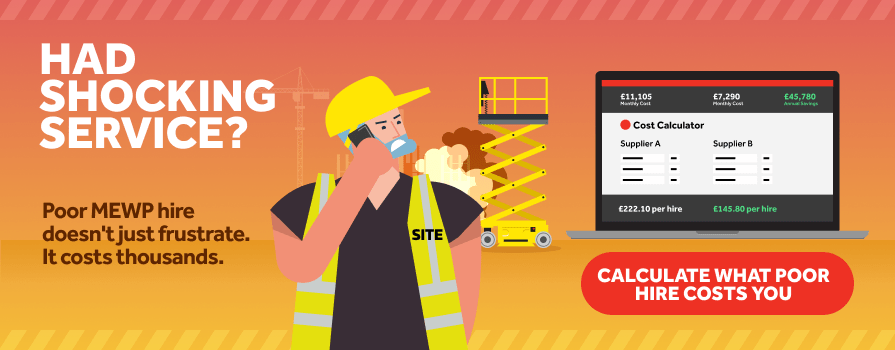
So, to help companies put numbers against machine failures, late deliveries and supply issues, Horizon has created a free Cost of Poor Hire Calculator. Click this button to learn more.

BREAKDOWNS ON SITE ARE THE BIGGEST PROBLEM
Asked which single issue caused their business the most monetary loss in the last 12 months from access hire failure, 31% of managers named breakdown on site – almost double the next-largest cause, late delivery or no-show (19%), and twice as many as named wrong specification (15%).
Across all MEWP hires in the last 12 months, the average breakdown rate reported by managers was 19%. Late deliveries averaged 16% of hires, no-shows 14%, and wrong-equipment deliveries 16%.
What this tells us is that the industry’s narrative is back-to-front. The biggest preventable cost is not logistics, it is fleet condition – a machine that arrives on time but fails on site does more damage than one that turns up late. That puts the focus on the depth of maintenance behind a hire: the preventative schedules, return-to-depot checks and pre-delivery inspections that decide whether a machine is genuinely fit to work.
Plenty of operators run a version of this, IPAF Rental+ accreditation holders among them, but the level of detail is not uniform – and the data suggests that gap is where the avoidable cost sits.
REGULATORY DELAYS GET WORSE
The Building Safety Regulator backlog has been one of the most-covered construction stories of the past two years. What is less visible: when projects do finally clear regulatory review, the supply chain often cannot keep up.
80% of UK construction managers say an access equipment hire failure has extended a project that was already delayed by planning, Building Safety Regulator approval or other regulatory hold-up in the past 12 months. 23% say it has happened more than once.
This is not a side-effect. For projects already operating on tight margins after months of approval delays, an access equipment failure that adds another fortnight to the programme is the difference between a profitable job and a write-off.
SUPPLIERS GOING UNDER
UK construction insolvencies have been at near-record highs throughout 2024 and 2025, and access equipment hire firms have not been spared. We expected the survey to show this. We did not expect it to show this much of it.
51% of the UK construction managers surveyed have had an access equipment hire supplier go into administration mid-project in the past 12 months. 71% have had to switch supplier mid-project because the original simply failed to deliver. 60% have switched because the supplier was otherwise unable to fulfil the contract.
For project managers, mid-contract supplier collapse is a particularly painful failure mode. Equipment has to be re-sourced at short notice, often at a premium. Subcontractor schedules have to be rebuilt around the new arrival window. The rest of the supply chain treats the project as higher-risk for months afterwards.
It is worth naming what often sits underneath these failures. Several of the suppliers going under are the ones that won work on the lowest rates, and a race to the bottom on price rarely leaves room for reinvestment. Squeeze the margin to win the contract and there is little left to put back into fleet, processes or people – so service slips, demand outstrips what the business can deliver, and the model eventually breaks.
The supplier that looked cheapest at tender becomes the most expensive once a project has to re-source mid-contract, at short notice and at a premium.
THE MARKET IS MOVING
The good news for the reliable suppliers: the market knows what is going on, and it is getting ready to move.
58% of UK construction managers said they were likely to switch their primary access equipment hire supplier in the next 12 months because of service issues – 22% very likely, 35% somewhat likely. A further 1% were already actively switching at the time of the survey.
And they are willing to pay for reliability. The average construction manager would pay a 13% premium in hire rates for a supplier that delivered reliably and was easy to deal with. 45% would pay 11-20% more. 14% would pay 21-40% more.
That is the most important finding in the whole survey for the industry as a whole. Years of price-driven procurement in MEWP hire have left contractors paying less per hire rate but more per project once you count the failures. The market is now telling us, in numbers, that it is ready to pay more for less hassle.
INTRODUCING THE COST OF POOR HIRE CALCULATOR
We have built a free Cost of Poor Hire Calculator to let you put your own figures against the industry-wide picture.
It is a side-by-side supplier comparison. Enter the relevant inputs for your current supplier in one column and a comparison supplier in the other, and the calculator tots up the cost difference once hire rates, breakdowns, downtime, penalties and rehires are factored in.
HOW TO USE THE CALCULATOR
Six essential fields per supplier, plus three optional fields. They work out as:
- Choose the machine type. Pick the closest match from the dropdown (12ft Electric Personnel Lift, 26ft Diesel Scissor, 45ft Bi-Fuel Boom Lift, and so on). If your kit is not listed, select “Other” and enter the description.
- Enter the hire rate per job. The number on your supplier’s invoice. The calculator does not care if it is weekly or daily – what matters is consistency between the two columns.
- How many MEWPs you hire per month. If it varies, take an average over the last six months.
- The number of hires resulting in an issue per month. Late deliveries, breakdowns, missing certificates, flat batteries, wrong-spec machines – anything that took the equipment out of useful service.
- Enter the impact: team members affected per issue, hourly rate per team member, average hours of downtime per issue. This is where the calculator does its real work – multiplying out the labour cost of a machine that does not show up or does not work.
- Add the optional fields if relevant: LADs (Liquidated and Ascertained Damages), rehired contractors or rebooked work, and any extra travel or accommodation forced by hire failures. Feel free to skip these if you do not have the figures.
Enter the details for Supplier A, then do the same for Supplier B.
Hit “Compare Suppliers” and the calculator shows you which supplier is actually delivering value and which is not. Like our research shows, it’s likely that poor service will be hitting you hard in many ways.
WHAT GOOD ACCESS EQUIPMENT HIRE LOOKS LIKE
The Censuswide research gives us a clear benchmark: 19% breakdown rate, 16% late deliveries, 14% no-shows, £6,343 per incident on average.
Across the same period, Horizon Platforms delivered:
- 98.4% on-time deliveries
- 98.0% trouble-free hire days
- 98.1% collections within 7 days
These numbers are not a coincidence. We have built the business around five things that keep them where they are: regular maintenance on every machine, return to depot checks, 40-point pre-delivery inspections, LOLER inspections and our 8 customer commitments – including 15-minute support response and an engineer on site within 3 hours of an equipment failure if one is needed.
We do not claim to be perfect. We claim 98%. And on the rare occasions we miss it, we say so and credit the delivery charge.
KNOW YOUR REAL COST OF HIRE
If there is one finding from the survey that should stay with you, it is that nearly half of UK construction managers have had access equipment hire failures cost them £5,000 or more on a single incident and most have been hit multiple times in the past 12 months.
The Cost of Poor Hire Calculator is there to make that cost visible.
We built it to be used by anyone who hires powered access equipment, not just our customers. Run it against your current supplier honestly. If the numbers say you are with the right one, you will know. If they do not, you will know that too.
Either way, the days of paying less per hire rate while losing more per project are coming to an end. The market has spoken.
Talk to Horizon about your access hire.